01 · BOOTUEFI entry and pixels
Build the toolchain, load directly from firmware, understand the hand-off and render correctly into the framebuffer.
Build a UEFI-native OS from an empty file to a polished desktop, storage, networking and a source-audited DOOM port. Join the founding list now; choose whether to reserve an offer later.
ForgeOS is not publicly launched. Your tier choice measures interest; it is not a purchase.
This is a real ForgeOS interface reference from the project source archive—not a stock dashboard mock-up.
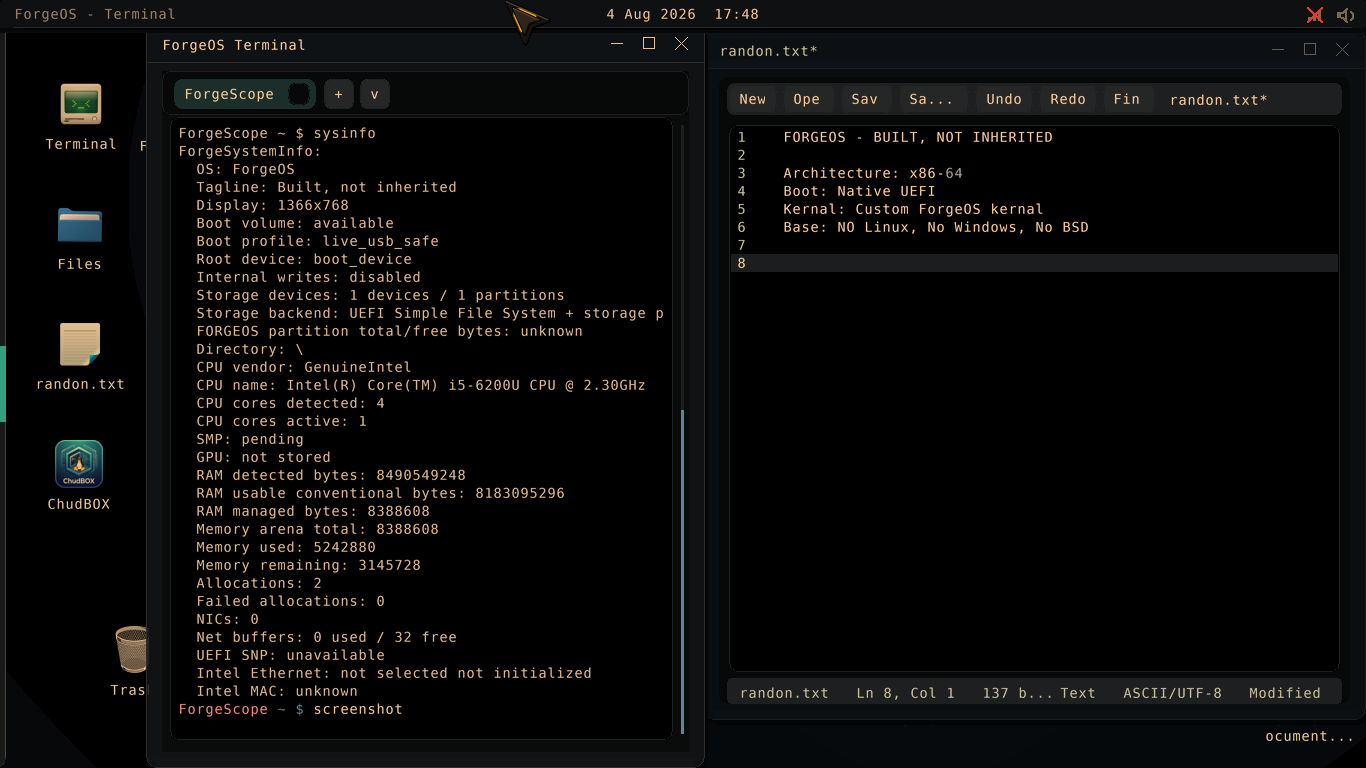
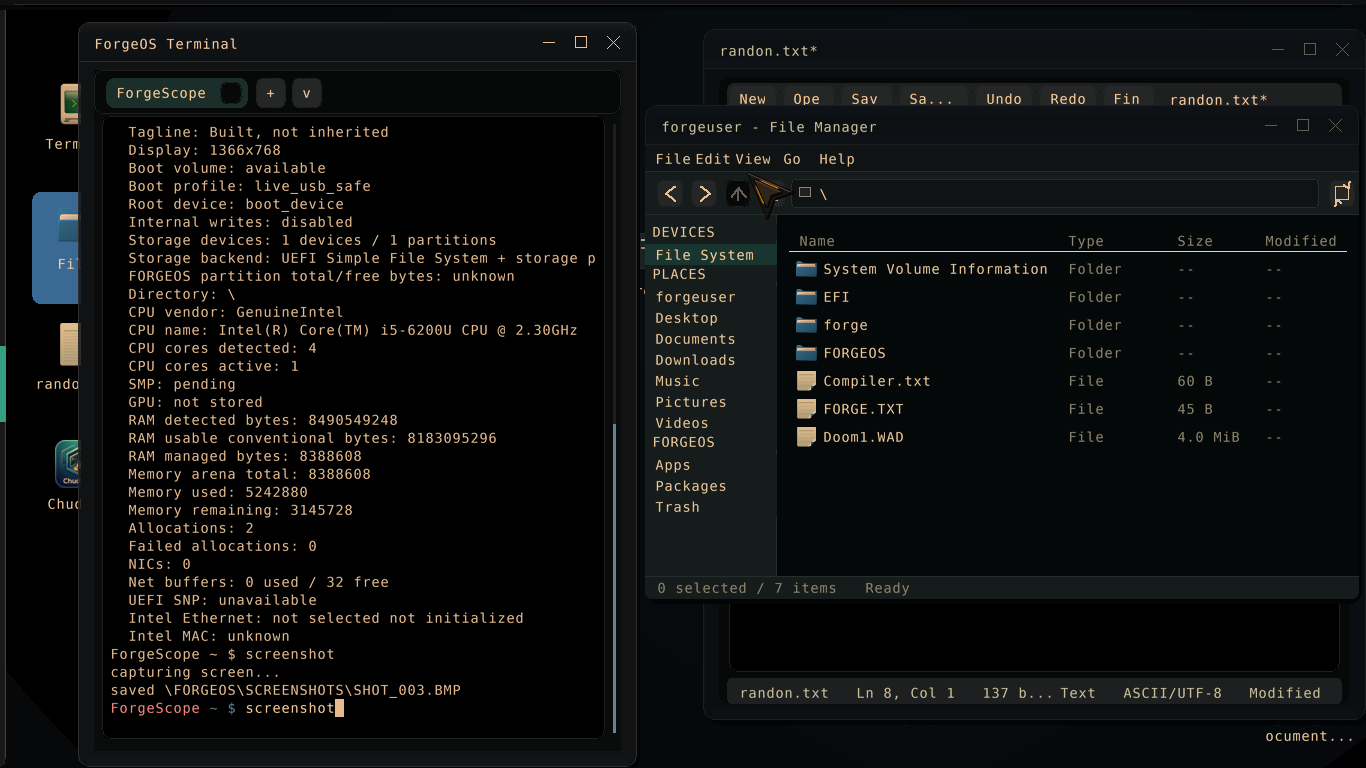
Start with modern firmware, own the framebuffer and memory map, then add the subsystems that turn boot code into an operating system.
01 · BOOTBuild the toolchain, load directly from firmware, understand the hand-off and render correctly into the framebuffer.
02 · KERNELOwn the memory map, timers and keyboard input, then build the real ForgeOS panic screen and contain user-process faults without taking down the kernel.
03 · DESKTOPImplement double buffering, dirty regions, text, controls, draggable windows and a coherent desktop.
04 · STORAGERead and write real files, load assets and move beyond a desktop that only exists in memory.
05 · NETWORKBring up Ethernet and build the network layers needed for connected ForgeOS applications.
06 · DOOMIntegrate doomgeneric callbacks for display, input, time and files using a legally obtained compatible WAD.
Joining the waitlist reserves your preference. Stripe Checkout is a separate step. There is no artificial quantity cap or countdown.
Normal price $9/month
$0 first month
$0 for your first month, then $9/month after launch
Recurring billing: Stripe requires a payment method and creates a subscription with a free trial through the first month after launch. You pay $0 today. After the trial it charges $9/month until cancelled.
Normal price $39/month
$0 first month
$0 for your first month, then $39/month after launch
Recurring billing: Stripe requires a payment method and creates a subscription with a free trial through the first month after launch. You pay $0 today. After the trial it charges $39/month until cancelled.
Normal price $149 once
$49 once
$49 founding-member price · one-time payment
One-time payment: Stripe charges $49 once. This is not a subscription and there are no recurring fees. Access covers the ForgeOS course and inclusions listed above.
ForgeOS is pre-launch, but the current course build and package boundaries are concrete. Founding members receive early access only after verified Stripe Checkout.
WRITTEN COURSEBoot to pixels, memory and interrupts, compositor, windows and desktop, USB and filesystems, networking, and Run DOOM.
GUIDED ROADMAPSNative runtime and applications; storage, hardware and performance; networked desktop; virtualisation and compatibility.
BUILDER FILESImportant-module archives, the Section 1 completion package, build assets, QEMU/USB tools and the verified DOOM integration patch.
LIFETIME FILESBuilder files plus current advanced-section packages, reconstructable ForgeOS source parts, hashes and future major course packages.
ACCOUNTRestore verified access by purchase email and a short-lived code. Manage recurring billing through Stripe’s Customer Portal.
NOT INCLUDEDNo promise of one-to-one support, unrelated future courses or products, commercial WAD files, or universal compatibility with every physical machine.
“Current build” means the material exists in the pre-launch course archive. “Guided roadmap” means the section teaches the implementation path without claiming every subsystem is a finished drop-in product.
UEFI toolchain, framebuffer, memory, interrupts, compositor and a draggable desktop.
USB mass storage, filesystems, Ethernet layers and application-port callbacks.
Processes, user memory, ELF loading, syscalls, threads, services and native apps.
AHCI, NVMe, display modes, CPU capabilities, memory pressure and profiling.
TLS, ForgeWeb, packages, VMX capability and staged hosted-emulation foundations.
“I detached UEFI’s own USB driver mid-boot and the firmware started spamming write errors. I hit a 64 KB DMA boundary that silently corrupted transfers. The UI ran in QEMU and black-screened on real silicon. ForgeOS turns those failures into the lesson path.”— ForgeOS founder · project source and build evidence retained with the course
// PixelsPerScanLine != HorizontalResolution
// QEMU may forgive this; physical panels will not.

buf[y * pitch + x] = colour;   // correct
buf[y * width + x] = colour;   // sheared output

// Treat hardware claims as measured evidence:
if (wc_policy_validated(fb_base, fb_size))
    enable_write_combining(fb_base, fb_size);
No. This is the pre-launch founding waitlist. The current course build exists, but the public launch has not happened. Waitlist members will receive the launch timing and founding-access path by email.
No. A waitlist signup is recorded as a lead, not a purchase. It does not create a Stripe customer, start a trial, take payment or grant course access.
You receive a branded confirmation email showing your selected tier. You can then choose whether to continue to Stripe Checkout when that tier’s checkout is available. Your founding offer is honoured according to the tier you selected.
Both are recurring subscriptions and require a payment method in Stripe Checkout. You pay $0 through the first month after launch, then the saved payment method is charged $9/month for Starter or $39/month for Builder until cancelled. ForgeOS sends a transactional reminder before the trial ends.
Use “Manage subscription” on the ForgeOS access page to open Stripe’s Customer Portal and cancel before the displayed trial end. ForgeOS sends a transactional reminder before billing. You can also email support@access.jirt.net.
Yes. The founding price is $49 once. It is not recurring. Lifetime means permanent access to this ForgeOS course, its current approved downloads, future written lesson updates and future major ForgeOS course section packages. It does not include unrelated products or one-to-one consulting.
Waitlist members do not. A founding member who completes verified Stripe Checkout receives access to the current course build. Access is granted from server-verified Stripe state—not from the browser return URL alone.
The supplied baseline is verified in QEMU/OVMF. The course teaches bounded tests on compatible UEFI hardware and how to record the exact machine and EFI hash. It does not promise universal physical-hardware compatibility.
Tell us what you want to build and which founding offer genuinely interests you. We’ll send the launch details—no fake countdown, no surprise charge.
Join the ForgeOS waitlist